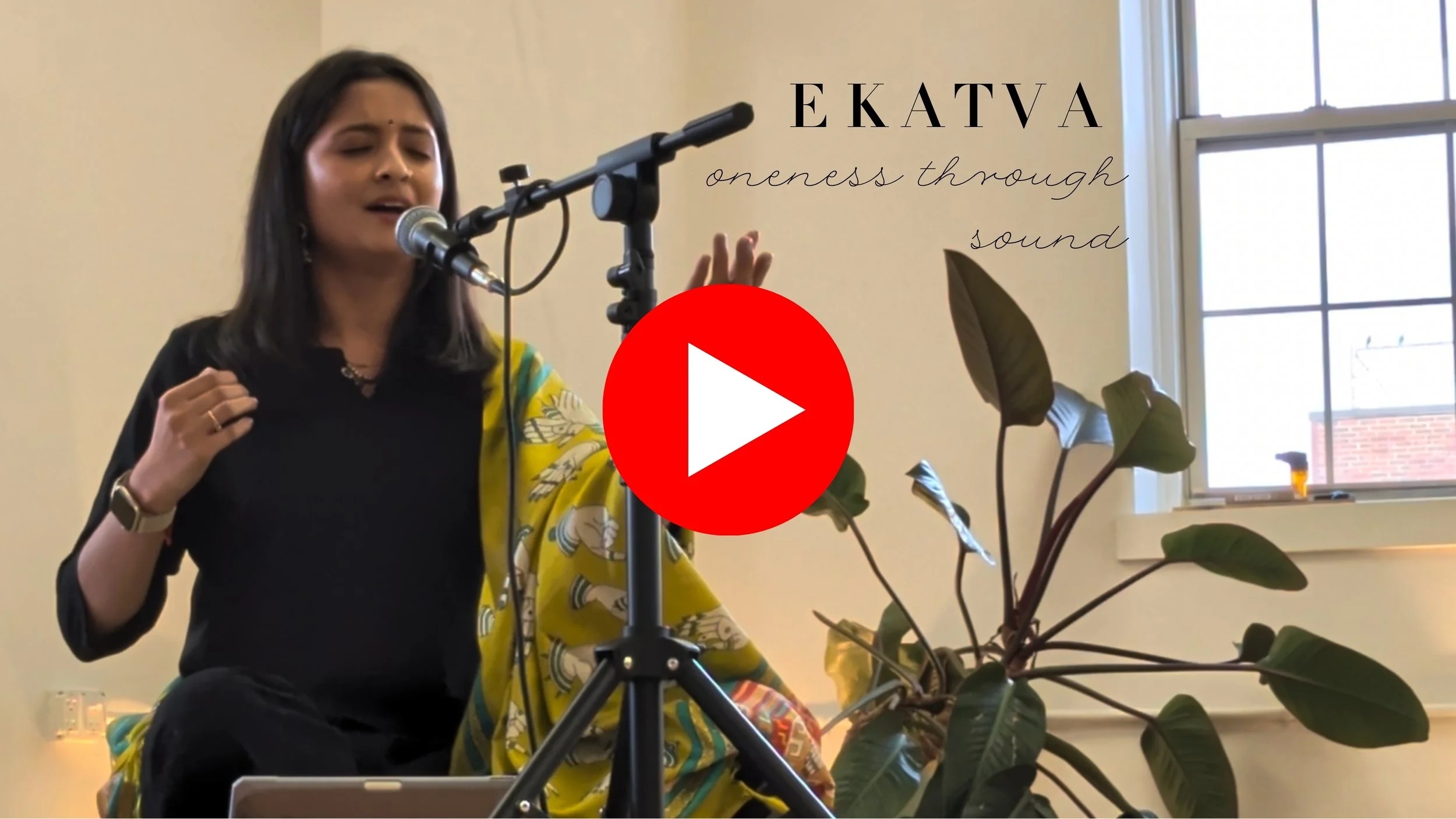
Ekatva: Oneness Through Sound
role: founder, researcher, vocalist
Ekatva (Sanskrit: "oneness") is a philosophical principle that recurs across Indian devotional, musical, and metaphysical traditions. While articulated differently within Vedantic, Bhakti, and Nāda philosophies, it fundamentally concerns the dissolution of apparent multiplicity into an underlying unity of existence. Rather than presenting this realization as abstract doctrine, many of India's saint-poets articulated it through vernacular poetry intended to be sung. In doing so, music became not only a vehicle for devotion, but also a medium through which complex philosophical ideas could be embodied, remembered, and collectively experienced.
This performance examines Ekatva through two compositions: Ek Sur Charachar Chhayo and Nirgunachya Sang. Both approach the concept of oneness from complementary perspectives. Although emerging from different poetic traditions, both works investigate the relationship between sound, perception, and non-dual awareness.
Ek Sur Charachar Chhayo presents the universe as resonating through a single primordial sound, positioning nāda(sound) not merely as a musical phenomenon but as a metaphor for ontological unity. Rather than describing sound as an aesthetic object, the composition imagines it as the principle through which apparent diversity is understood as an expression of an indivisible whole.
This sonic vision finds philosophical resonance in Nirgunachya Sang, an abhang attributed to Gora Kumbhar. The text describes the transformative experience of dwelling in the company of the Nirguna (the formless Absolute, without attributes) where attachment to multiplicity dissolves and only the One remains. Here, non-duality is not presented as speculative philosophy, but as an embodied realization cultivated through devotional practice.
Presented together, these compositions construct a performative trajectory from hearing unity to realizing unity. The first invites listeners to perceive the cosmos as a single resonant field; the second suggests that this resonance ultimately points beyond sound toward the formless reality from which it emerges. In dialogue, they ask how musical performance can function not only as interpretation, but also as a mode of philosophical inquiry.
This performance forms part of the larger Sant Vaani research project, which investigates the musical traditions surrounding India's saint-poets as living archives of philosophical thought. Through archival research, textual analysis, oral tradition, and Hindustani classical performance, the project explores how devotional music has historically served as a site for transmitting ideas across linguistic, regional, and sectarian boundaries. Rather than treating these compositions as historical artifacts, Sant Vaani approaches performance as a research methodology— one that asks how singing, listening, and musical interpretation can generate new understandings of concepts such as Ekatva, Nāda, and the Nirguna within contemporary artistic practice.